
Think about how a young child discovers the world.
They shake a toy to hear what happens. They stack blocks and knock them down. They count fingers, trace shapes, sing rhymes, jump over lines and ask endless questions.
They rarely learn by simply sitting still and listening.
That distinction matters because effective early childhood education should work with the natural way young minds explore—not against it.
Multi-sensory learning builds on this idea by involving several senses in the learning process. Instead of merely telling a child that three plus two equals five, for example, you might let them hold three objects, add two more, count them aloud and visually see the new group.
At i-Maths, children explore mathematical and thinking concepts through experiences designed to make learning active, meaningful and enjoyable.
So, what makes this approach so powerful?
What Does Multi-Sensory Learning Actually Mean?
A simple multi-sensory learning definition for parents is this: it is an approach that teaches a concept through two or more senses rather than relying on only listening or looking.
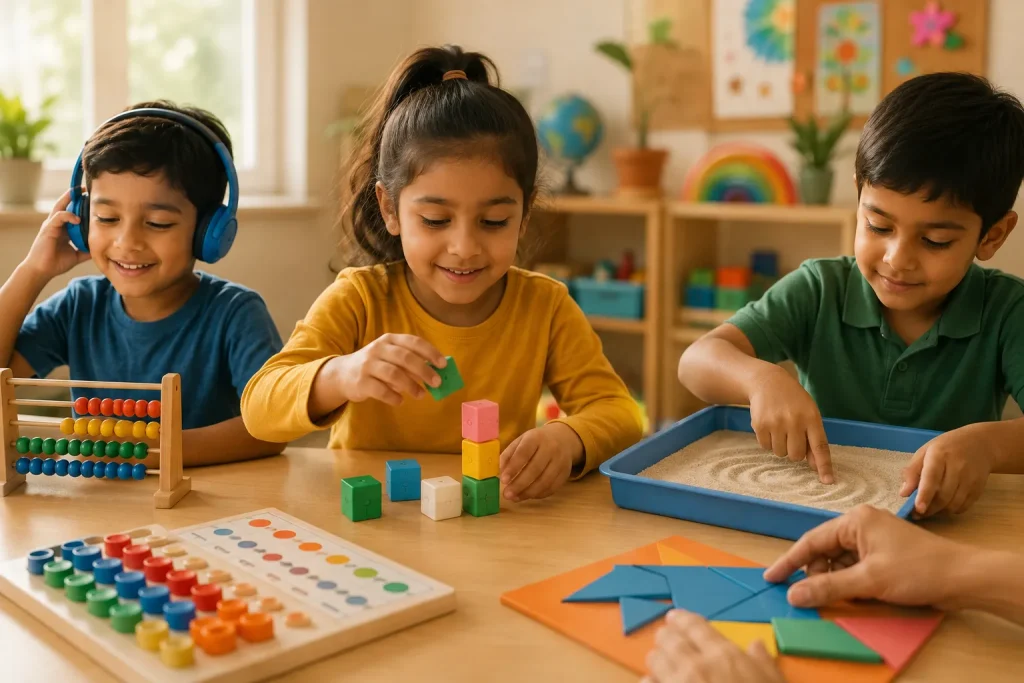
A child might:
- see colourful objects,
- hear numbers spoken aloud,
- touch and arrange manipulatives,
- move their body while counting,
- draw or construct a pattern.
The goal isn’t to add activity merely for entertainment. Each experience gives the child another way to interact with the same underlying idea.
Consider learning the number 6.
A child could look at the numeral “6,” say “six” aloud, clap six times, place six counters on a table and trace the numeral with a finger.
It is still one concept—but experienced in several ways.
This is also why auditory visual kinesthetic learning preschool activities can feel dramatically different from conventional worksheet-based practice. Children aren’t simply receiving information; they’re doing something with it.
Why Does Multi-Sensory Learning Work So Well During the Early Years?
Between the ages of three and six, children are developing rapidly across cognitive, physical, linguistic, emotional and social domains.
As explored in what happens inside the preschool brain between ages 3–6, these years provide important opportunities to build foundational skills and learning habits.
Multi-sensory experiences suit this developmental stage because young children naturally learn through exploration.
1. Abstract Ideas Become Something Children Can Experience
“Five is greater than three” sounds simple to an adult.
But to a four-year-old, greater than is an abstract relationship.
Give the child one pile containing five counters and another containing three, and suddenly the comparison can be seen and touched.
That helps explain why hands-on learning works better for kids, particularly when concepts are new or abstract.
Hands-on learning can help mathematical ideas stick because children get an opportunity to manipulate, test and experience concepts instead of simply being told what they mean.
2. Children Have More Ways to Connect With a Concept
Imagine explaining a pattern verbally to a preschooler.
Some children may understand immediately. Others may need to see the pattern. Another child might understand it only after arranging the objects themselves.
Multi-sensory teaching doesn’t force every child through one narrow doorway.
It opens several.
This is one reason how multi-sensory teaching helps preschoolers goes beyond simply making lessons more entertaining. It creates multiple opportunities for a child to engage with and understand an idea.
3. Movement Turns Learning Into Participation
For young children, movement isn’t necessarily the opposite of concentration.
It can be part of concentration.
Counting jumps, creating shapes with the body, sorting objects or physically arranging a sequence gives children something meaningful to do while they think.
Rather than treating an active preschooler as a problem to solve, multi-sensory teaching can channel that natural energy into learning.
What Does Multi-Sensory Math Look Like?
Math is particularly well suited to multi-sensory exploration because numbers, quantities, patterns and spatial relationships can all be represented physically.
Some of the best multi-sensory activities for young children can also be surprisingly simple.
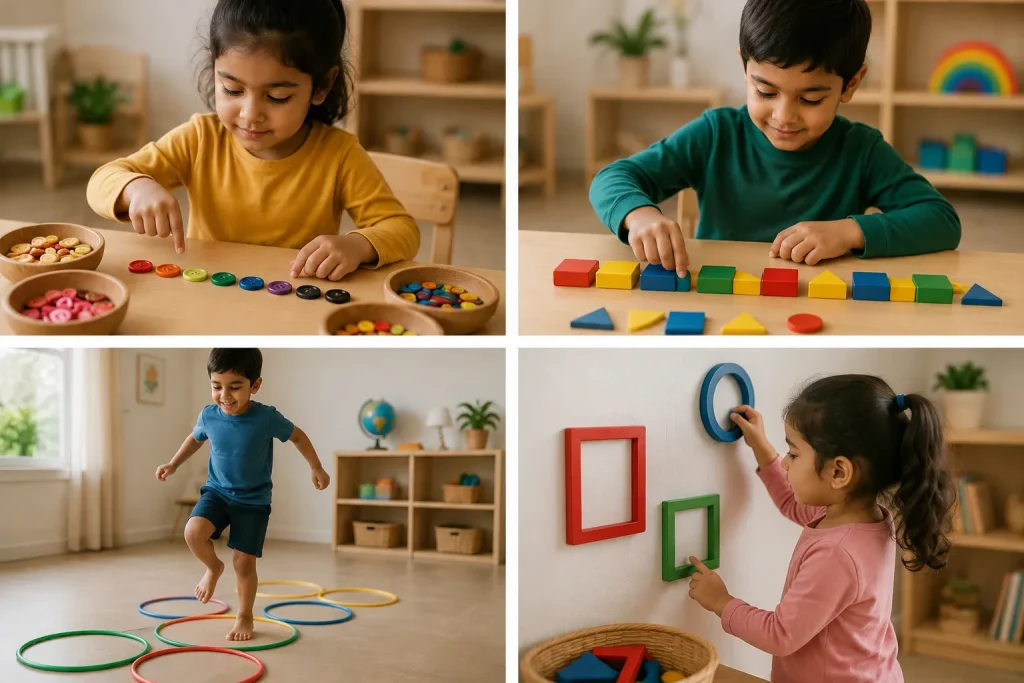
Count What You Can Touch
Instead of only asking “What comes after four?”, give children buttons, blocks, beads or other safe objects to count and group.
Build Patterns
Use shapes, colours or everyday objects to create a repeating pattern and ask children to predict what comes next.
Turn Numbers Into Movement
“Take four steps.”
“Jump three times.”
“Clap twice.”
Now numbers represent real quantities rather than symbols on a page.
Explore Shapes Around You
Ask children to find circles, squares or rectangles around the room. Let them trace, build or draw those shapes afterward.
These multi-sensory math activities for toddlers and preschool-aged children help connect mathematical language with experiences children can observe and understand.
Multi-Sensory Learning Is Also About Thinking Differently
One of the most interesting benefits of experiential learning is that children don’t always arrive at an answer in the same way.
Give five children the same collection of blocks and ask them to create two equal groups. You may see several approaches before reaching the same solution.
That variation is valuable.
It encourages children to experiment rather than waiting to be shown the “correct” procedure immediately.
This connects naturally with lateral thinking for children and the value of finding different paths to a solution.
Strong learning isn’t simply about remembering more answers. It’s also about becoming comfortable exploring possibilities.
From “Tell Me the Answer” to “Let Me Try”
A conventional learning environment can sometimes become heavily dependent on instruction:
Teacher explains → child listens → child repeats.
Multi-sensory learning shifts that relationship toward:
Explore → notice → try → adjust → understand.
That small shift can make learning feel less like information being delivered to a child and more like a discovery the child participated in.
It reflects a broader principle behind brain-based learning for early childhood: learning experiences should take children’s developmental needs and natural ways of exploring into account.
And when children are encouraged to manipulate ideas instead of merely memorizing answers, mistakes can become part of exploration rather than something to fear.
How i-Maths Makes Learning an Experience
Parents researching how i-Maths uses multi-sensory teaching methods will notice that the program isn’t designed around passive repetition alone.
The i-Maths teaching methodology for young learners encourages children to explore concepts through engaging activities that support thinking, observation and problem-solving.
The learning experience is complemented by i-Maths course material which is designed for interactive early learning, helping turn concepts into experiences children can interact with.
Instead of making math feel like a collection of rules children must remember, the approach helps children explore the reasoning behind ideas.
That difference matters.
Because a child who understands why something works has something much more useful than a memorized answer.
The Question Isn't “Which Sense Does My Child Learn With?”
Parents sometimes wonder whether their child is primarily a visual, auditory or kinesthetic learner.
A more useful question may be:
How many meaningful ways can my child experience this idea?
A child doesn’t necessarily need to be placed into one learning category.
The same child may benefit from seeing a concept today, physically exploring it tomorrow and explaining it aloud later.
Multi-sensory learning gives children that flexibility.
And perhaps that’s its greatest strength: instead of asking a young brain to adapt to one rigid method of teaching, teaching becomes flexible enough to meet a young brain where it is.
When Children Experience Math, They Stop Seeing It as “Just Math”
For a preschooler, learning shouldn’t always look like learning.
It can look like building.
Sorting.
Moving.
Listening.
Experimenting.
Playing.
As children explore numbers, patterns, shapes and relationships through multiple senses, abstract ideas can gradually become meaningful experiences.
That is the real promise of multi-sensory learning—not simply making lessons more colourful or active, but helping children participate in their own understanding.
At i-Maths, young children are encouraged to discover concepts through experiences that make mathematics more engaging and approachable.
Curious what multi-sensory learning could look like for your child?
Book an i-Maths free trial class and let your child explore math through hands-on learning. Sometimes the best way to understand a new approach to learning is to let your child experience it.
FAQs:
Multi-sensory learning teaches a concept using multiple senses—such as sight, sound, touch and movement—so children can interact with information in several meaningful ways.
Young children naturally explore their surroundings physically and through their senses. Combining movement, objects, sounds and visuals can make abstract information easier to understand and engage with.
Counting physical objects, building patterns with blocks, tracing numbers, singing counting rhymes, sorting objects and using movement to represent quantities are simple examples.
It can help children connect mathematical symbols with actual quantities, shapes, patterns and relationships. This makes concepts more concrete before children progress toward abstract mathematical thinking.
Multi-sensory approaches can provide children with more than one way to access and interact with information, which may be helpful for diverse learning needs. Individual requirements, however, should always be considered when choosing an educational approach.
Traditional instruction may rely heavily on verbal explanation, observation and worksheets, while multi-sensory teaching deliberately incorporates experiences such as touching, manipulating, speaking and moving.
Children can benefit from sensory exploration from their earliest years, with age-appropriate activities becoming increasingly structured during toddler and preschool stages.
Look for a program that combines purposeful hands-on activities with age-appropriate concepts, encourages children to think and explore, and makes activities meaningful rather than simply keeping children busy.