
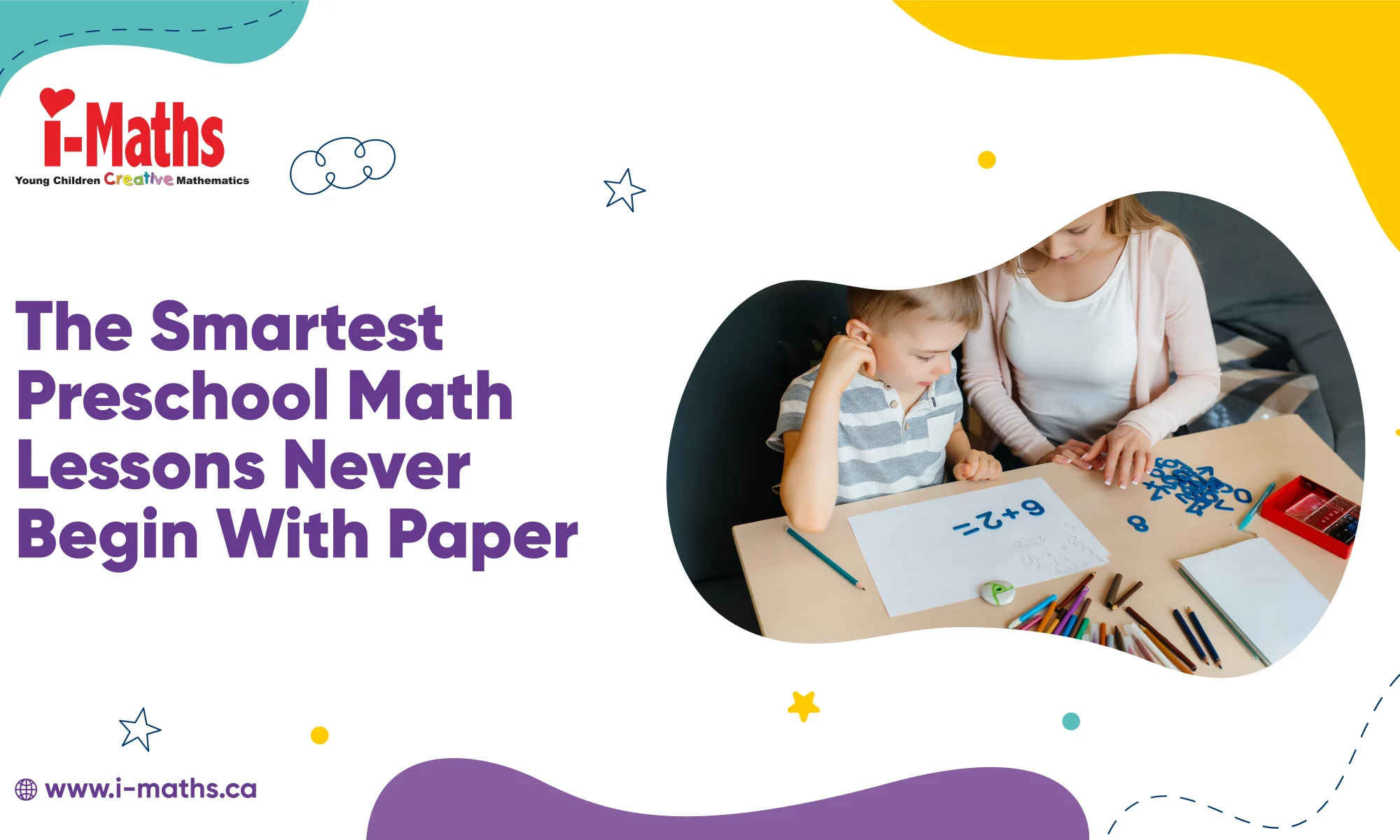
Children are naturally curious. They count their toys, compare the sizes of cookies, notice patterns on the floor, and ask questions about everything around them. These everyday moments are where real mathematics begins—not inside stacks of worksheets.
At i-Maths Canada, we believe meaningful learning happens through exploration, movement, conversation, and play. Instead of memorizing answers on paper, children develop genuine mathematical understanding by experiencing numbers in real life.
The good news? Teaching math doesn’t require expensive materials or complicated lesson plans. It simply requires creating opportunities for children to discover mathematical ideas naturally.
Why Worksheets Aren't Always the Best Teacher
Worksheets certainly have their place for practice and review. However, for preschool-aged children, they rarely provide the rich learning experiences that developing brains need.
Young children learn best when they can:
- Touch and manipulate objects
- Move their bodies
- Experiment freely
- Ask questions
- Solve simple problems independently
Instead of simply recognizing numbers on paper, children begin understanding what numbers actually represent. This foundation becomes much stronger than rote memorization.
That’s why many educators are shifting toward no worksheet teaching methods that encourage exploration instead of repetition.
Why Play Is the Language of Early Math
Play isn’t a break from learning.
For preschoolers, play is learning.
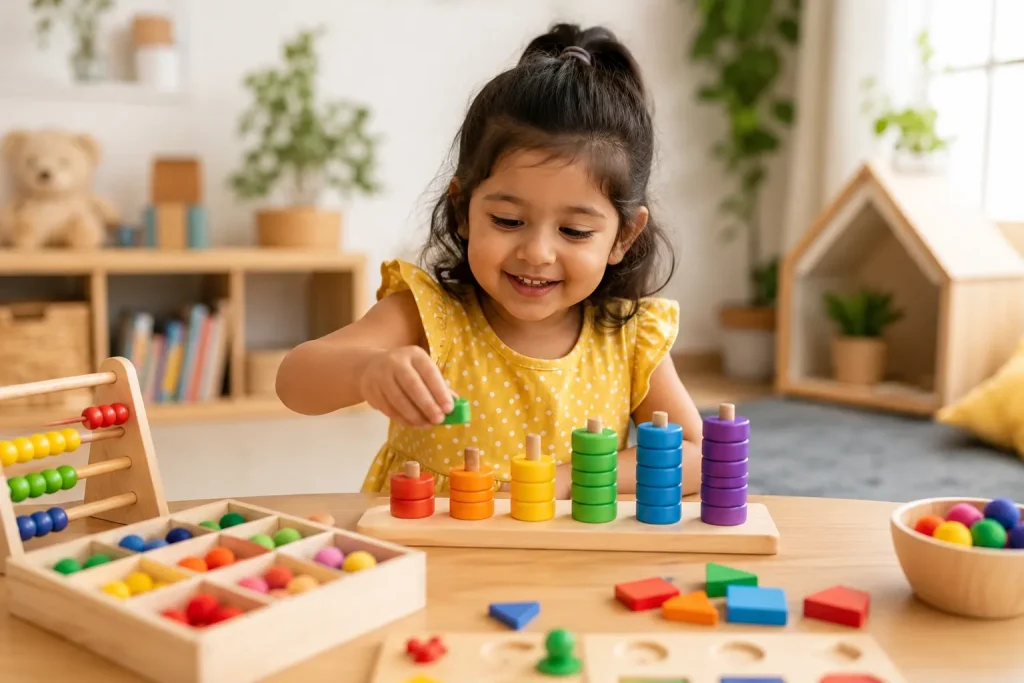
Whether children are building towers, sorting toys, pouring water, or arranging blocks, they are constantly practicing mathematical thinking.
This approach, often called play-based math learning, develops skills such as:
- Counting
- Comparing quantities
- Pattern recognition
- Measurement
- Problem-solving
- Logical reasoning
Unlike worksheets, these experiences are memorable because children actively participate in discovering the answers themselves.
1. Turn Everyday Objects into Math Tools
You don’t need fancy educational toys.
Your home already contains countless opportunities for hands-on math activities.
Try using:
- Building blocks
- Buttons
- Bottle caps
- Fruits
- Kitchen spoons
- Coins
- LEGO pieces
Ask questions like:
- Which pile has more?
- Can you make groups of five?
- Which object is heavier?
- Can you build a taller tower?
Children naturally develop number sense while playing instead of feeling like they’re completing a lesson.
2. Make Counting Part of Everyday Life
Counting should never feel like homework.
Instead, weave it into daily routines.
Count:
- Steps while climbing stairs
- Apples in the grocery cart
- Cars passing outside
- Toys during cleanup
- Flowers in the garden
These simple routines become powerful math activities for preschoolers because they connect numbers with real experiences.
If you’re looking for additional counting ideas, explore this helpful resource on Why Counting Activities Boost Preschool Brain Development.
3. Teach Shapes Through Exploration
Children don’t truly understand shapes by tracing them on paper.
They understand shapes by finding them everywhere.
Encourage your child to discover:
- Circular plates
- Rectangular books
- Square windows
- Triangular road signs
- Oval mirrors
Turn it into a fun scavenger hunt.
The more children observe shapes in everyday environments, the stronger their visual reasoning becomes.
Learn more about shape recognition in this article Why Shapes Matter in Preschool Learning.
4. Add Movement to Every Math Lesson
Children remember concepts better when movement is involved.
Instead of asking them to sit still:
- Hop five times.
- Jump to number cards.
- Toss bean bags into numbered buckets.
- Walk in different patterns.
- Race while counting aloud.
These activities combine physical movement with interactive math for kids, making learning more engaging and easier to remember.
Movement also improves attention and keeps young learners excited about discovering new ideas.
5. Let Children Solve Real-Life Problems
One of the best examples of teaching math creatively is allowing children to solve authentic problems.
For example:
“We have four people at dinner. How many plates do we need?”
“Can you divide these grapes equally?”
“Which container holds more water?”
“How many blocks do we need to make both towers the same height?”
These practical situations help children understand why math matters instead of seeing it as another school subject.
6. Play Games That Build Mathematical Thinking
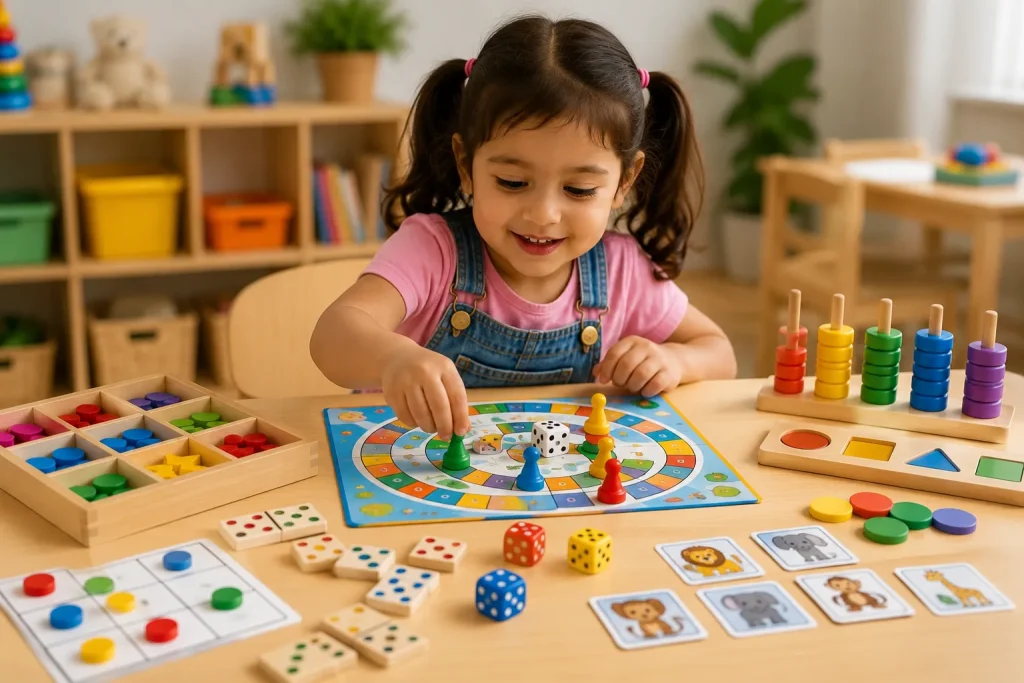
Games naturally encourage children to think, predict, compare, and calculate.
Some excellent options include:
- Dice games
- Dominoes
- Number bingo
- Pattern matching
- Memory games
- Board games involving counting
- Sorting challenges
Many of these fun math learning methods improve attention span, decision-making, and logical reasoning without children even realizing they’re learning.
The excitement of playing keeps motivation high while strengthening foundational math skills.
7. Encourage Open-Ended Exploration
Not every activity needs one correct answer.
Sometimes the richest learning happens when children experiment.
Ask questions such as:
- How many different ways can you make 10?
- Can you build a bridge using only six blocks?
- What pattern can you create?
- Can you sort these objects another way?
This type of exploration develops flexibility in thinking and encourages children to explain their reasoning.
Instead of memorizing procedures, they begin understanding mathematical relationships.
Why Experiential Learning Creates Stronger Math Skills
Children remember experiences far longer than worksheets.
When they pour water between containers, compare object sizes, or build structures, they create meaningful mental connections.
This approach is known as experiential learning because children learn by doing rather than simply observing.
Research in early childhood education consistently shows that active participation strengthens understanding, confidence, and long-term retention.
That’s why many educators now prefer experiences over repetitive paper exercises during the preschool years.
Small Daily Moments Matter More Than Long Lessons
Parents often believe math learning requires formal study sessions.
In reality, five minutes of playful exploration every day is often more valuable than an hour of worksheet practice.
Simple opportunities include:
• Setting the dinner table
• Baking together
• Organizing toys
• Building with blocks
• Gardening
• Grocery shopping
These everyday routines provide continuous opportunities for children to observe numbers, compare quantities, recognize patterns, and solve problems naturally.
Over time, these consistent experiences build strong mathematical confidence.
School Readiness Is About Confidence, Not Perfection
Parents often worry whether their child knows enough before school begins.
The truth is that kindergarten teachers expect children to arrive with varying academic abilities. What matters most is whether children are willing to learn, interact, adapt, and participate.
If your child can manage emotions, follow routines, and build positive relationships, they already possess many of the foundations needed for school success.
If you’re looking for supportive programs that help build confidence, independence, and readiness skills, then read this guide on how to find the right preschool for your child.
Helping Children Enjoy Math for Life
The ultimate goal isn’t simply teaching children to count.
It’s helping them enjoy thinking mathematically.
When children discover that math exists everywhere—in games, stories, cooking, nature, and everyday conversations—they develop curiosity instead of fear.
At i-Maths, we focus on making early mathematics meaningful, engaging, and enjoyable through interactive experiences that prepare children for lifelong success.
By embracing play-based math learning, hands-on math activities, and interactive math for kids, i-maths along with the support of parents can nurture confident learners who see mathematics as something enjoyable rather than intimidating.
Help your child build confidence through engaging, age-appropriate learning experiences with i-Maths Canada. Get started today.
FAQs:
Children learn math effectively through games, storytelling, everyday activities, counting objects, building blocks, cooking, and outdoor exploration. These experiences help children understand mathematical concepts naturally instead of memorizing answers.
Worksheets can reinforce concepts after children understand them, but they shouldn’t be the primary teaching method for preschoolers. Young learners benefit much more from active, hands-on experiences that engage multiple senses.
Games, puzzles, cooking, measuring ingredients, counting toys, building with blocks, sorting objects, scavenger hunts, and movement activities are all enjoyable ways to introduce math concepts while keeping children engaged.
Connect math to everyday life by involving children in shopping, baking, gardening, and play. When children see math solving real problems, they become more motivated to learn.
Hands-on math activities involve physically exploring mathematical ideas using objects such as blocks, counters, puzzles, measuring tools, or household items. These activities help children understand concepts through direct experience.
Absolutely. Play encourages children to count, compare, sort, measure, recognize patterns, and solve problems naturally. This playful approach strengthens early mathematical thinking while keeping learning enjoyable.
Experiential math learning means learning mathematics by doing rather than simply reading or writing answers. Children develop deeper understanding by actively exploring numbers, shapes, measurements, and patterns through meaningful real-life experiences.