
For a preschooler, an ordinary day is filled with opportunities for development. Getting dressed encourages independence. Playing develops imagination and problem-solving. Conversations build language. Even following a familiar bedtime sequence can help create a sense of predictability.
That is why a good routine isn’t simply about keeping the household organized.
Research has associated family routines with positive social-emotional outcomes in preschool-aged children, while research on self-regulation highlights its importance for learning and school readiness.
At i-Maths, we believe early learning should nurture the whole child through age-appropriate, engaging experiences. So, what does a science-backed daily routine for preschoolers actually look like?
Let’s build one.
Why Do Daily Routines Matter for Preschoolers?
Between ages three and five, children are developing rapidly across cognitive, physical, social, and emotional areas. Understanding what happens in the preschool brain between ages 3 and 6 can help parents see why everyday experiences matter so much during these years.
Research on routines and child development suggests that consistency can provide a useful framework for healthy development. One study involving preschool-aged children found that greater participation in family routines was associated with a higher likelihood of positive social-emotional health.
However, creating a healthy routine for young children doesn’t mean planning every 15 minutes.
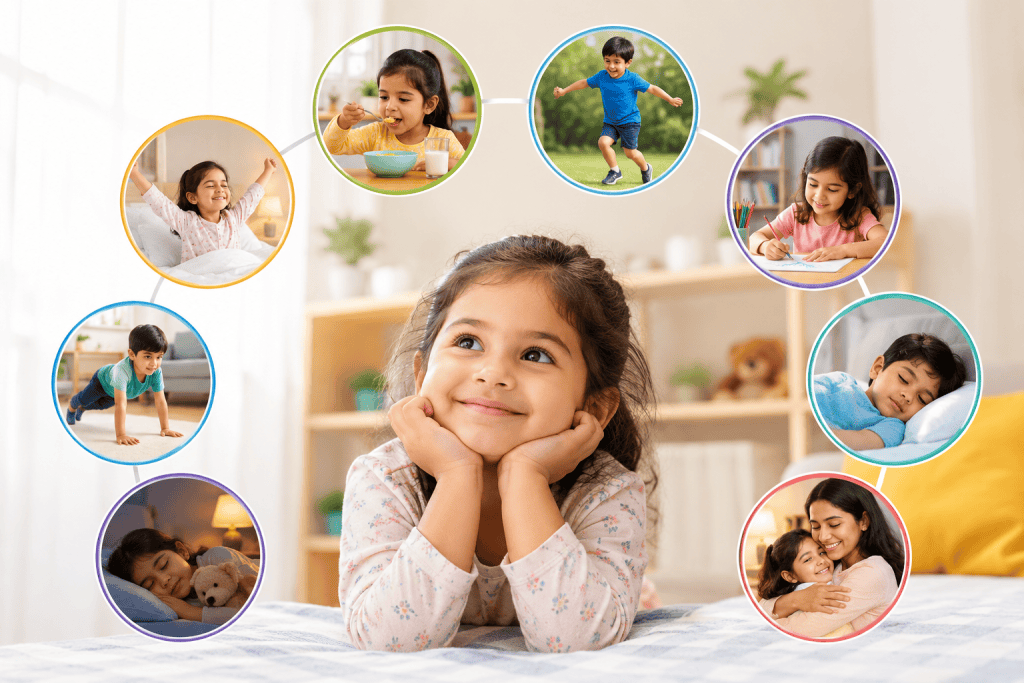
Think of a routine as a predictable rhythm: wake, connect, eat, move, learn, play, rest, reconnect, and sleep.
A Science-Backed Daily Routine for Preschoolers
There is no single schedule that works for every family. A child’s preschool hours, nap requirements, family commitments, and individual sleep needs will all affect the timetable.
Instead of asking only how to structure a preschooler’s day, parents can build the day around a few reliable anchors.
7:00–8:00 AM: Wake Up and Start Slowly
What time should preschoolers wake up and sleep? There isn’t one universal clock time. What matters more is getting enough total sleep and maintaining reasonably consistent sleep and wake times.
Children ages 3–5 are generally recommended to get 10–13 hours of sleep per 24 hours, including naps.
A morning routine for toddlers and preschoolers might include:
- waking and getting dressed
- brushing teeth and washing up
- eating a nutritious breakfast
- talking about the day ahead
- completing one small independent task
Simple responsibilities such as putting pajamas away or carrying a breakfast plate to the counter can also encourage independence.
8:00–10:00 AM: Active Play and Exploration
Young children need movement—not just organized exercise.
For children ages 3–4, the World Health Organization recommends at least 180 minutes of varied physical activity spread throughout the day, including at least 60 minutes of moderate-to-vigorous activity.
Outdoor play, running, dancing, climbing, ball games, and imaginative movement can all contribute.
The goal is not to turn exercise into another lesson. Let children move, explore, experiment, and have fun.
10:00–11:30 AM: Short, Playful Learning
Preschoolers do not need hours of worksheets to have a productive learning day.
Blocks, puzzles, sorting games, counting objects, storytelling, patterns, crafts, and hands-on experiments can introduce important concepts while keeping learning engaging.
Programs such as the i-Maths Kindergarten Math Program use interactive activities to encourage children to explore mathematical concepts through experience and discovery.
Parents wondering whether their child is approaching the next stage can also look for these key signs of kindergarten readiness.
11:30 AM–1:00 PM: Lunch, Conversation and Quiet Time
Meals can be learning opportunities without feeling like lessons.
Ask questions such as, “Which fruit is bigger?” or “How many pieces are on your plate?” More importantly, use mealtime for conversation and connection.
Research has found associations between family routines—including family dinners, storytelling, singing, and play—and positive social-emotional outcomes among preschool-aged children.
This is also where parent involvement in early education becomes part of everyday life rather than a separate teaching activity.
1:00–3:00 PM: Nap or Quiet Rest
Not every preschooler will still nap, particularly as they get closer to school age. Quiet time, however, can still create a useful break in a busy day.
Books, drawing, puzzles, soft music, or independent play can provide lower-stimulation alternatives.
The ideal sleep and play balance for preschoolers should reflect individual needs while still protecting adequate total sleep.
3:00–6:00 PM: Snack, Free Play and Family Time
Afternoons can include outdoor play, pretend play, building, drawing, helping with household tasks, or meeting other children.
Unstructured play matters too. A healthy routine should leave room for children to make choices rather than turning the entire day into adult-directed activities.
If you have been searching for an early learning centre near me, look for a program that balances structured learning with active, developmentally appropriate exploration. Parents can explore the i-Maths preschool program near you to learn more.
6:00–8:00 PM: Dinner and Wind-Down
Evenings should gradually shift from energetic activities toward calmer ones.
Dinner, family conversation, a bath, pajamas, storytelling, and cuddling can form predictable cues that bedtime is approaching.
Screen-free time is valuable here. WHO guidance for children ages 3–4 recommends limiting sedentary screen time to no more than one hour per day, with less considered better.
Replacing some evening screen time with reading, storytelling, or conversation can make the transition toward bedtime calmer.
What Does the Best Schedule for a 3–5 Year Old at Home Really Need?
The best schedule for a 3-5 year old at home is not necessarily the most detailed one.
It needs balance.
Children need sufficient sleep, physical movement, nutritious meals, opportunities to learn, independent and imaginative play, social interaction, and meaningful connection with caregivers.
Research also identifies self-regulation as an important part of school readiness because it helps children engage with learning, regulate attention and behaviour, and adapt to classroom expectations.
Predictable routines can give children repeated opportunities to practice everyday skills such as following sequences, transitioning between activities, waiting, completing simple responsibilities, and preparing for what comes next.
The Best Preschool Routine Is Consistent; Not Perfect
A preschooler’s routine should serve the child, not control the family.
Some days bedtime will be late. Sometimes lunch happens on the go. A birthday party may replace quiet time, and rainy weather may keep everyone indoors.
That is okay.
What matters is maintaining a generally predictable rhythm while responding to your child’s individual needs.
A balanced day filled with sleep, movement, conversation, play, exploration, and warm interaction can provide a strong environment for development.
At i-Maths, children experience learning through engaging activities designed to encourage exploration, thinking, and age-appropriate skill development.
Want to add enriching learning experiences to your child’s routine? Enroll with i-Maths and help make learning an exciting part of their everyday world.
FAQs:
It combines adequate sleep, active and imaginative play, age-appropriate learning, meals, quiet time, family interaction, and a predictable bedtime routine.
Children ages 3–5 generally need 10–13 hours of sleep per 24 hours, including naps.
Aim for plenty of active and free play, short engaging learning experiences, quiet periods, and enough sleep rather than filling the day with formal instruction.
Predictable routines can provide repeated opportunities to practice attention, transitions, independence, emotional regulation, and other developing self-regulation skills.
Yes. Screen-free periods create more room for movement, conversation, reading, imaginative play, and hands-on exploration.
There is no universal bedtime or wake time. Choose times that allow the child to consistently receive the recommended amount of sleep while fitting the family’s schedule.
Routines help children become familiar with transitions, following sequences, completing tasks, listening, and managing expectations—all useful behaviours when entering a classroom environment.
Include physical play, pretend play, books and storytelling, creative activities, simple math and problem-solving experiences, family conversation, outdoor time, independent play, and adequate rest.