

Walk into a room full of preschoolers and learning may not look the way adults expect.
One child is sorting colourful objects. Another is building a tower and figuring out why it keeps falling. Two children are pretending to run a grocery store, counting items and negotiating who gets to be the cashier. Somewhere else, a teacher is guiding children through a number activity.
So, which children are actually learning?
Potentially, all of them.
The debate around play-based learning vs structured learning comparison often makes parents feel they need to pick a side. But early childhood learning doesn’t have to be an either-or decision. Young children can benefit from opportunities to explore freely as well as thoughtfully designed, age-appropriate guidance.
At i-Maths, an engaging early learning program for young children, learning is designed around this idea: children can develop important foundational skills while remaining curious, active and involved in the process.
What Is Play-Based Learning?
Play-based learning gives children opportunities to explore concepts through activities that feel meaningful and enjoyable to them.
Think building blocks, puzzles, sorting games, pretend shops, patterns, shapes, movement and hands-on experiments. Well-designed preschool learning activities can introduce children to concepts such as numbers, measurement, problem-solving and spatial awareness without making learning feel like a formal lesson.
One of the major benefits of play-based learning for preschoolers is that children become active participants. Instead of simply receiving information, they experiment, make choices, notice patterns and try again when something doesn’t work.
For example, a child building a block tower may be discovering balance and size. A pretend shop can introduce counting and comparison. Even arranging toys according to colour or shape can encourage classification and logical thinking.
This is also why hands-on learning can help mathematical concepts become more meaningful for children. When children can touch, move and experience an idea, an abstract concept can become easier to understand.
What Does Structured Learning Look Like for Preschoolers?
Structured learning generally involves an adult setting a particular objective and guiding children toward it.
A teacher might introduce a number concept, lead a pattern activity or ask children to solve an age-appropriate problem. There is usually a clearer beginning, purpose and direction than there would be during completely free play.
Parents wondering, “is structured learning better for toddlers?” should consider what structured actually means.
Structure does not have to mean long lessons, repetitive worksheets or expecting a three-year-old to sit quietly for extended periods. For young children, good structured learning can still involve movement, manipulatives, stories, games and interaction.
The key is making the structure appropriate for a child’s developmental stage.
Play vs Structure: Do We Really Need to Choose?
This is where the debate becomes more interesting.
Free play gives children independence. Structured experiences can introduce concepts and provide direction. One creates room for discovery, while the other can help children focus on a particular skill.
So instead of asking which approach should win, a more useful question might be:
How can we give children enough freedom to explore while providing enough guidance to help them progress?
Research on play-based learning outcomes has increasingly encouraged educators to look beyond a simple play-versus-instruction divide. Guided play, for example, combines a playful environment with an intentional learning goal and gentle adult support.
You can dive deeper into this by reading this i-Maths guide on early childhood education myths and facts. It mentions that preschoolers do not just need elementary-school classrooms, they need more experiences designed around how young minds naturally engage with the world.
Why Play Matters More Than It May Appear
To an adult, a child playing with buttons, blocks or toy animals may simply look busy.
Look closer, and there may be much more happening.
Children can practise communication while negotiating a game, develop spatial reasoning while constructing something, strengthen creativity through pretend play and encounter early mathematical concepts through sorting, counting and comparing.
This is one reason parents asking how much free play do preschoolers need should think beyond a strict daily number. Children benefit from meaningful opportunities for self-directed play throughout their day, alongside physical activity, social interaction, rest and guided learning.
Parents can also explore screen-free math activities for toddlers that turn everyday play into learning opportunities without making home feel like another classroom.
Where Structured Learning Adds Value
If play offers exploration, thoughtful structure can add intention.
Imagine children are playing with different shapes. An educator might ask:
“Which shapes can roll?”
“Can you build something using only triangles and squares?”
“What happens if we turn this shape around?”
The children are still touching, testing and discovering. But the adult’s questions encourage them to think about a specific idea.
This type of purposeful guidance is central to the i-Maths teaching method, which uses engaging activities to develop mathematical thinking. The objective is not simply getting children to complete tasks. It is encouraging them to observe, question, reason and explore.
What Does the Best Preschool Learning Approach in Canada Look Like?
There is no single classroom formula that will suit every child. However, quality early learning generally recognizes that young children learn through relationships, exploration, play and developmentally appropriate guidance.
That means the best preschool learning approach Canada families look for may not sit at either extreme.
A program focused almost entirely on formal instruction may leave too little room for exploration. On the other hand, an environment without thoughtful guidance can miss opportunities to extend a child’s thinking.
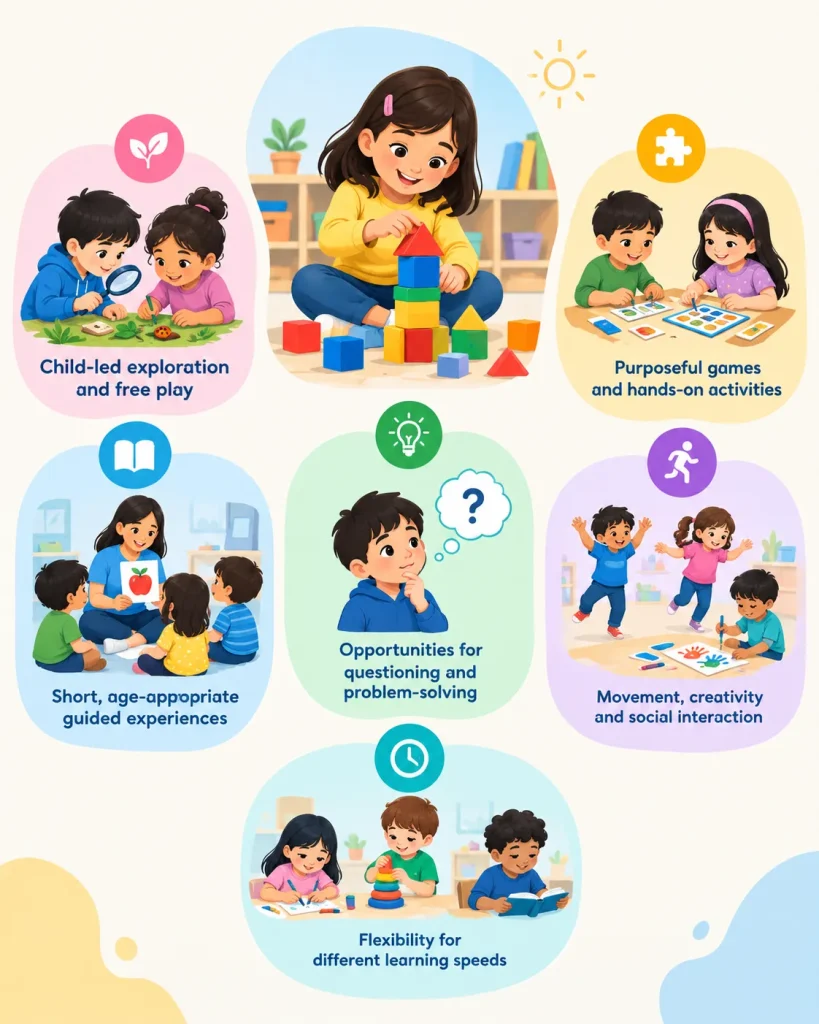
A balanced environment can include:
- Child-led exploration and free play
- Purposeful games and hands-on activities
- Short, age-appropriate guided experiences
- Opportunities for questioning and problem-solving
- Movement, creativity and social interaction
- Enough flexibility to accommodate different learning speeds
Parents evaluating an early learning center can look at how its environment and activities support young children’s development, rather than focusing only on how many academic concepts are being introduced.
How Parents Can Combine Play and Structure at Home
You don’t need to recreate a preschool classroom in your living room.
In fact, learning opportunities are already hiding in everyday routines.
If you’re wondering how to combine play and structured learning at home, start with something your child already enjoys and add a small challenge or question.
Building with blocks? Ask which tower is taller.
Putting away toys? Sort them by colour, type or size.
Setting the table? Count how many plates everyone needs.
Playing with toy cars? Create a simple pattern using different colours.
Cooking together? Talk about quantities, shapes and measurements.
This approach makes learning intentional without taking away the fun. It can also help children understand that maths and problem-solving are not limited to books or classrooms. They are part of everyday life.
The Goal Isn't More Learning. It's Better Learning.
The early years should not become a race to see who can read, count or complete worksheets first.
They are a time for children to become curious about how things work, confident enough to try, comfortable with making mistakes and excited to discover something new.
That is why the play-versus-structure debate can sometimes miss the bigger picture.
Children need space to explore, but they can also benefit from adults who know when to introduce an idea, ask a useful question or provide the next challenge.
At i-Maths, early mathematical learning combines engaging experiences with purposeful skill development, helping children discover concepts in ways that make sense for their age.
Give your child an opportunity to experience learning that encourages curiosity, thinking and exploration. Enroll your child in the i-Maths program and discover an engaging approach to building early mathematical skills.
FAQs:
Play-based learning gives children more freedom to explore through play, while structured learning involves more intentional adult guidance toward a particular skill or concept.
Neither needs to replace the other. A thoughtful combination of child-led play and age-appropriate guided learning can support both exploration and skill development.
Preschoolers should have regular opportunities for free and active play throughout the day rather than spending long periods on formal academic tasks.
Play can help develop skills useful for kindergarten, including communication, problem-solving, independence, self-regulation and early literacy and numeracy concepts.
An excessive focus on formal, adult-directed academic activities can reduce opportunities for movement, creativity and child-led exploration. Structure is most useful when it remains developmentally appropriate and engaging.
Research generally supports play as an important part of early childhood development, while evidence around guided play suggests that playful experiences can also be intentionally designed around learning goals.
Strong programs often combine opportunities for exploration and social play with carefully planned, age-appropriate activities guided by educators.
Use everyday play as a starting point and introduce simple questions, challenges, counting, sorting or problem-solving. The goal is to extend your child’s thinking without turning every activity into a formal lesson.