
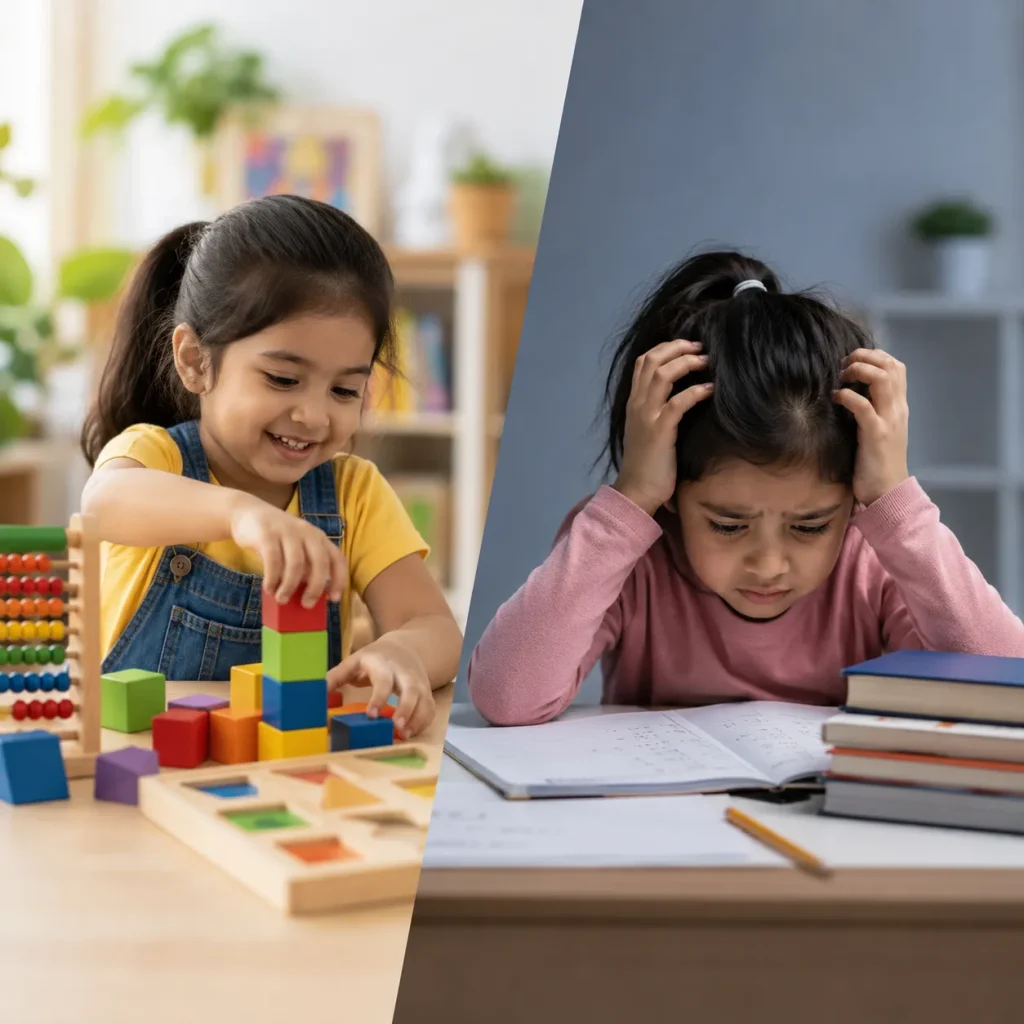
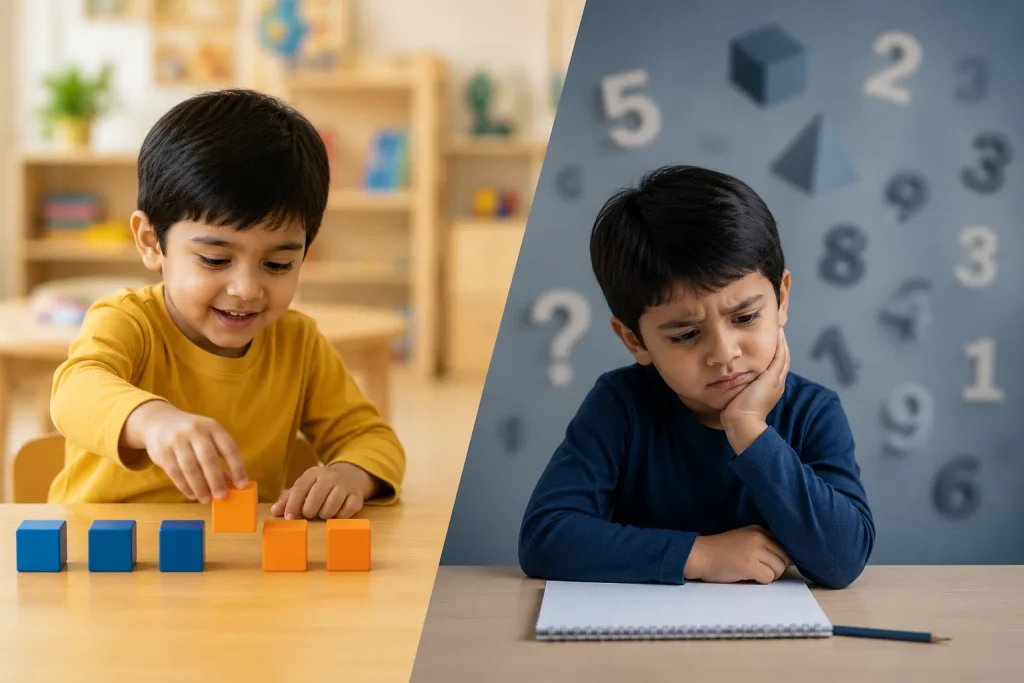
Ask a three-year-old to sort colourful blocks, find the bigger cookie, build a pattern, or count how many toys they have, and they will probably jump right in.
Tell the same child a few years later that it is time to “do math,” and the reaction may be completely different.
“I can’t do it.”
“I’m not good at math.”
“This is too hard.”
Where did that confidence disappear?
Children are naturally surrounded by mathematical thinking long before they recognize it as “math.” The problem is that their relationship with numbers can gradually change when curiosity is replaced by pressure, comparison, fear of mistakes, or repeated frustration.
Understanding math anxiety in young children is therefore about much more than improving academic performance. It is about protecting a child’s willingness to explore, experiment, and try.
At i-Maths, math is introduced through purposeful play, exploration, hands-on experiences, and real-life application so young children can develop mathematical thinking without seeing learning as something intimidating.
Math Anxiety Can Begin Before a Child Understands the Word “Anxiety”
Math anxiety is an uncomfortable emotional response associated with mathematical situations. For a young child, however, it rarely sounds like, “I have anxiety about mathematics.”
It may sound more like:
- “I don’t want to do this.”
- “You do it for me.”
- “I’ll get it wrong.”
- “Math is boring.”
- “She’s better than me.”
Some signs of math anxiety in kids under 6 can also appear behaviourally. A child may avoid number-based activities, become unusually upset after making mistakes, constantly ask whether an answer is correct, or give up quickly when an activity involves counting or problem-solving.
This matters because early experiences help shape how children perceive themselves as learners.
To understand why experiential learning is so important during these years, parents can explore The Science Behind How Children Learn Math – i-Maths.
Why Do Children Develop Negative Math Attitudes?
There usually isn’t one dramatic moment that makes a child dislike mathematics. Instead, negative associations can develop through repeated everyday experiences.
1. Math Becomes About Getting the “Right” Answer
Imagine a preschooler trying to solve a puzzle.
They try one piece. It doesn’t fit. They rotate it. Still wrong. They choose another.
Nobody calls those attempts failures.
Yet when math begins, adults can unintentionally treat every incorrect answer as something that must immediately be corrected. Children may gradually learn that experimenting in math is risky.
Instead, ask:
“How did you think about that?”
The conversation shifts from performance to thinking.
2. Adults Pass Their Own Math Anxiety Down
“I was terrible at math too.”
It may sound comforting, but children can interpret it differently: Maybe people in our family just aren’t good at math.
Although individual abilities are influenced by many factors, being “bad at math” is not simply an inherited destiny. Learning experiences, attitudes, teaching methods, confidence, and practice all influence mathematical development.
Parents don’t have to pretend math is effortless. Try saying, “That was difficult for me too, but we can figure difficult things out.”
3. Children Are Compared Too Early
“Your brother could count to 50 at your age.”
“Look how quickly your friend finished.”
Comparison can turn discovery into competition.
Young children develop at different speeds. The goal should be progress and understanding—not being the fastest child in the room.
This is one reason parents should question common assumptions about what young children “should” already know. This guide on Early Childhood Education Myths and Facts explores several misconceptions surrounding early learning.
4. Math Becomes Too Abstract, Too Soon
Young children understand their world through seeing, touching, moving, experimenting, and asking questions.
Give a child five blocks and remove two. The idea becomes visible.
Put “5 – 2 = ?” on paper before the child understands what subtraction represents, and math suddenly becomes an unfamiliar language.
This guide on How Hands-On Learning Makes Math Stick explains why physical and experiential learning can help children understand mathematical ideas more naturally.
How to Prevent Math Fear in Preschoolers
Preventing anxiety doesn’t require turning your living room into a classroom.
In fact, one of the best approaches is to make mathematical thinking part of ordinary life.
Ask your child to:
- Find three red objects in the room.
- Divide snacks equally between two people.
- Guess which container holds more water.
- Create a pattern using toys.
- Compare which tower is taller.
- Spot circles and rectangles while walking outside.
The child is practising numbers, classification, measurement, geometry, patterns, estimation, and reasoning—but it doesn’t necessarily feel like a lesson.
That distinction can be powerful.
Make Mistakes Normal—Especially Your Own
One of the most effective parent tips to reduce math anxiety in kids is surprisingly simple: let children see adults make mistakes calmly.
Try saying:
“Oops! That didn’t work. Let me try another way.”
Now the child learns something bigger than the answer itself.
They learn that mistakes are information.
When children aren’t terrified of getting something wrong, they become more willing to test ideas—and that willingness is central to helping children overcome fear of math.
Replace “You're So Smart” With Better Praise
“You’re so smart!” sounds positive, but it can unintentionally make children feel they need to keep proving that they are smart.
Instead, praise the process:
“You kept trying even when it was difficult.”
“That was an interesting way to solve it.”
“You tried two different ideas!”
“You noticed the pattern yourself.”
The objective is to build math confidence in early childhood around curiosity, persistence, reasoning, and discovery rather than speed or perfect answers.
When Should Parents Consider Early Intervention?
Parents shouldn’t panic because a four-year-old occasionally says, “I don’t like numbers.”
But consistent avoidance deserves attention.
Early interventions for math anxiety preschoolers should focus on changing the child’s experience before increasing the workload. More worksheets may not solve a confidence problem.
Instead, reduce pressure and return to concrete, playful experiences. Give children manageable challenges and enough time to solve them independently.
If you’re considering structured early learning, explore the i-Maths Math for Toddlers FAQs to learn more about the program approach and benefits. The i-Maths approach uses purposeful play and different learning methods to develop mathematical understanding and confidence rather than focusing only on arithmetic.
Can a Math Learning Center Actually Reduce Math Fear?
It can—provided the environment doesn’t simply introduce more pressure.
A good math learning center for young children should encourage exploration, questions, multiple approaches, and hands-on discovery. Children need opportunities to understand why something works rather than merely being told what to memorize.
At i-Maths, concepts progress through concrete, semi-abstract, and abstract learning experiences. Children first interact with three-dimensional tools, move toward visual representations, and then apply their understanding through activities.
This progression can make unfamiliar mathematical concepts feel more approachable.
Don't Raise a Child Who Is “Good at Math.” Raise One Who Isn't Afraid to Try.
Perhaps the biggest mistake adults make is assuming early mathematics should be about getting children ahead.
It doesn’t have to be.
The early years are an opportunity to build something more valuable: curiosity.
When children are comfortable asking questions, trying different solutions, making mistakes, and trying again, math becomes something to investigate rather than something to fear.
That is ultimately how to prevent math fear in preschoolers: don’t make perfection the goal.
Make discovery the goal.
At i-Maths, children aged 3–7 experience math through purposeful play, exploration, experimentation, presentation, and real-world application—helping establish a strong foundation for learning while keeping the experience engaging.
Book an i-Maths Free Trial Class today and help your child discover math differently.
FAQs:
Children may begin fearing math after repeated frustration, pressure to find the correct answer, comparison with others, or exposure to negative attitudes about mathematics. Early experiences can strongly influence whether children view math as interesting or intimidating.
Possible signs include avoiding number activities, becoming upset over mistakes, giving up quickly, repeatedly saying “I can’t do it,” or needing constant reassurance. Occasional frustration is normal; repeated avoidance may indicate a developing negative association.
Keep early math playful, use numbers naturally in everyday situations, avoid comparisons, and treat mistakes as part of learning. Focus praise on effort, strategies, and curiosity instead of speed and correct answers.
Mathematical ability isn’t simply a fixed family trait. A child’s learning environment, experiences, confidence, teaching, opportunities to practise, and attitudes toward mistakes can all influence mathematical development.
Adults may create pressure by emphasizing speed, immediately correcting every mistake, comparing children, or saying things such as “I’m bad at math too.” These behaviours can unintentionally teach children that mathematical ability is fixed and mistakes should be feared.
Start by lowering pressure rather than increasing practice. Use concrete objects, games, real-life problems, and small achievable challenges to rebuild the child’s confidence gradually.
Yes, when the learning environment emphasizes age-appropriate exploration and understanding rather than performance alone. Programs using purposeful play and hands-on learning can help children experience math in a more positive way.
Negative attitudes toward math can emerge during the early childhood and elementary years, although the timing differs from child to child. Building positive experiences before formal academic pressure increases can help protect a child’s confidence.