
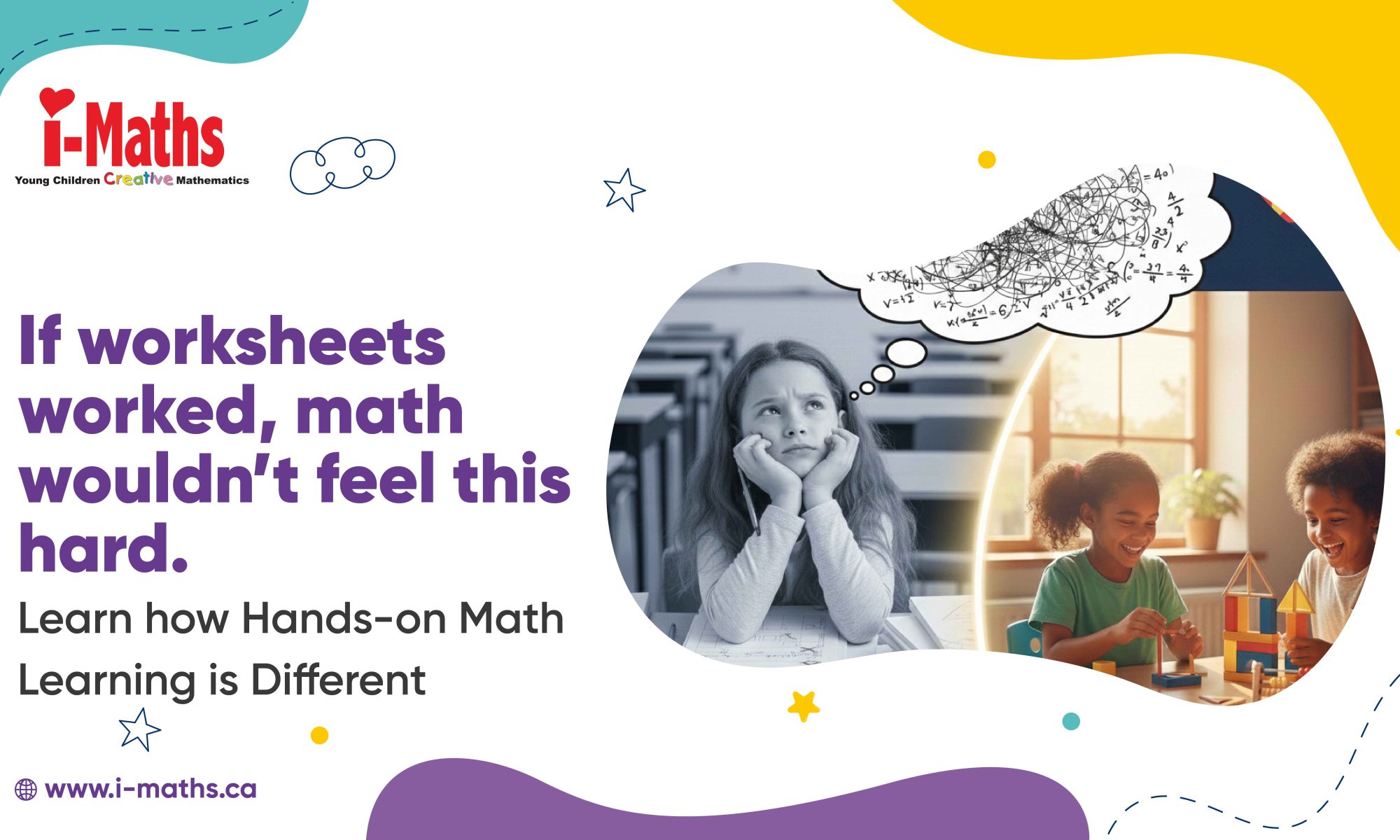
Ask any parent this question: “Does your child remember math after exams?”
Most will pause. Then sigh.
That’s because for many children, math is learned to score, not to understand. Once the test is over, the formulas fade, confidence drops, and the cycle repeats.
This is exactly where hands-on math learning changes the story.
At i-Maths, math is not treated as a subject to memorize, but as a skill children experience – using movement, visuals, and reasoning. And when children experience math, it sticks. Not just for exams, but for life.
Let’s unpack why that happens.
What Is Hands-On Learning in Math?
Before we talk about results, let’s get clear on what hands-on math actually means—and what it doesn’t.
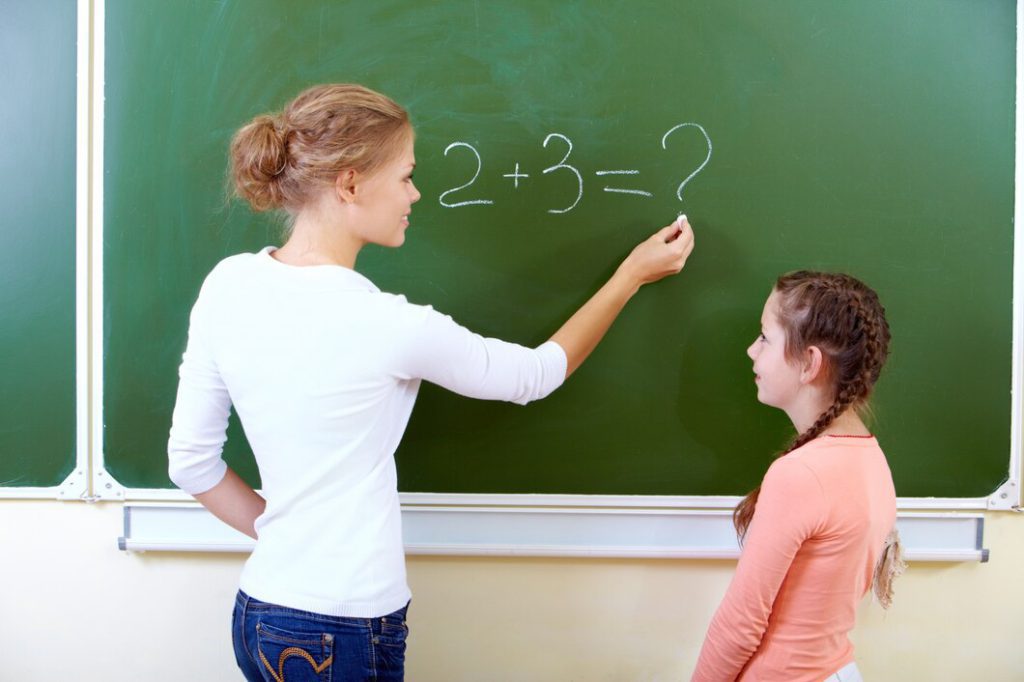
Learning by Doing, Not Memorizing
Hands-on learning means children actively engage with math concepts instead of passively receiving information. They touch, move, group, visualize, and experiment.
This form of experiential learning shifts the child from “listener” to “thinker.” Instead of memorizing steps, they discover patterns. Instead of repeating answers, they build understanding. When hands and brain work together, learning becomes faster—and far more meaningful.
Concrete → Visual → Abstract (The Learning Progression)
Effective math learning follows a natural progression:
- Concrete: physical objects, tools, movement
- Visual: patterns, diagrams, mental images
- Abstract: numbers, symbols, equations
Traditional teaching often jumps straight to abstract symbols. That’s where confusion begins. Hands-on learning respects how children think—by grounding abstract ideas in tangible experiences first.
Why Hands-On Math Is Especially Important in Early Years
Young children don’t learn best by sitting still. Their brains rely heavily on sensory input—touch, movement, and visuals—to make sense of the world.
Worksheets alone ignore this reality. Tactile learning, on the other hand, aligns with natural brain development and helps children truly own what they learn.
The Science Behind Why Hands-On Learning Makes Math Stick
This isn’t just a teaching preference—it’s brain science.
How the Brain Learns Through Movement and Touch
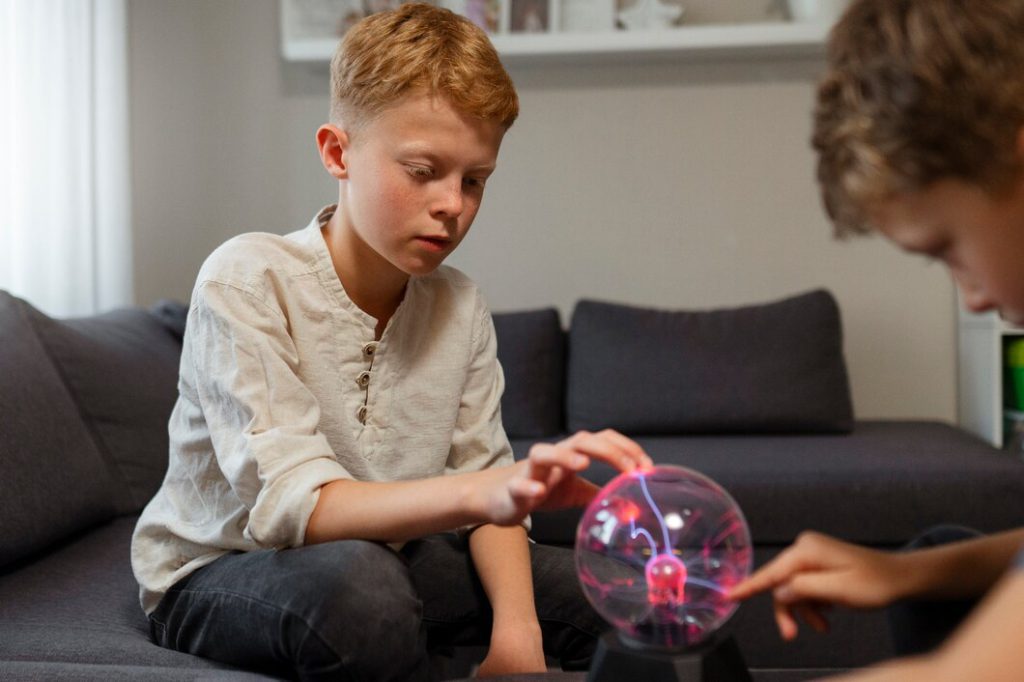
When children use their hands, multiple areas of the brain activate simultaneously. This multisensory engagement strengthens memory pathways.
That’s why children remember things they do far longer than things they only hear. Movement and touch turn abstract ideas into lived experiences.
Stronger Neural Connections Through Active Engagement
Listening creates short-term memory. Doing creates long-term understanding.
Repeated hands-on practice builds deeper neural connections, making it easier for children to recall and apply concepts later. This is why experiential learning leads to transferable skills, not just temporary exam readiness.
Visual Thinking and Mental Math Development
Hands-on tools help children see numbers instead of guessing them. Over time, physical tools evolve into mental images.
This visual thinking builds strong number sense, reducing dependence on formulas and calculators—and forming the foundation for confident mental math.
Key Benefits of Hands-On Math Learning for Children
This is where parents really start to see the difference.
1. Better Conceptual Understanding
Children understand why math works, not just how to get the answer. Concepts connect logically, leaving fewer gaps as learning progresses.
2. Improved Focus and Engagement
Active learning keeps children involved. When they are participating instead of observing, attention improves naturally, and distractions reduce.
3. Stronger Problem-Solving Skills
Hands-on math trains children to approach unfamiliar problems with confidence. They learn to think, test, adjust, and reason—skills that go far beyond the classroom.
4. Long-Term Retention (Math That Stays for Life)
Because concepts are experienced deeply, children retain them years later. This long-term retention supports academic confidence across subjects, not just math.
5. Positive Math Mindset
When learning feels achievable, fear disappears. Children begin to enjoy math, trust their thinking, and approach challenges without anxiety.
Many of these are also the benefits of play-based learning, which supports curiosity, confidence, and cognitive development in children.
Hands-On Math Activities That Actually Work
Let’s get practical—because parents love seeing how this works in real life. Here are some hands-on activities that parents can try at home for hands-on math learning:
1. Using Physical Objects to Build Number Sense
Beads, blocks, counters, and everyday items make numbers tangible. Children don’t just count—they understand quantity, comparison, and relationships.
2. Visual Pattern and Spatial Activities
Sorting, grouping, and pattern recognition strengthen visual-spatial intelligence. These skills directly impact logical reasoning and mathematical fluency.
3. Movement-Based Math Activities
Jumping, clapping, stepping, and body movement help children internalize quantities and operations. Kinesthetic learning boosts memory by involving the whole body.
4. Mental Visualization Exercises
Over time, physical tools fade into mental images. Children learn to “see” numbers in their mind—an essential step toward independent mental calculation.
How i-Maths Applies Hands-On Learning the Right Way
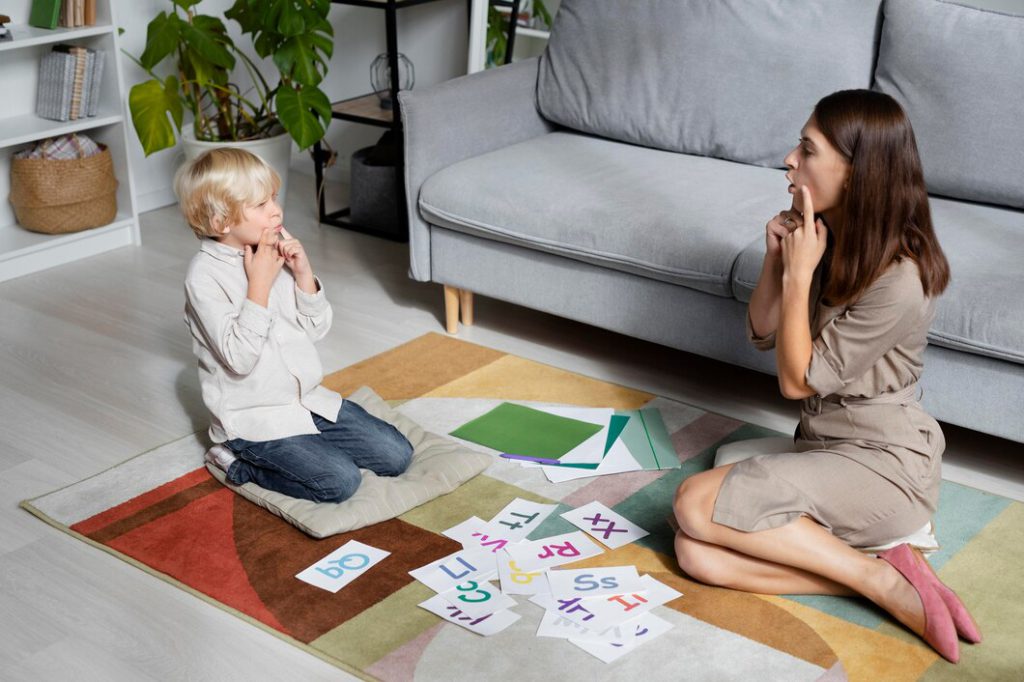
i-Maths doesn’t just use hands-on activities—it structures them with purpose. At i-Maths we build strong foundations before speed. When children understand deeply, speed follows naturally—without pressure or confusion.
Our structured and age-appropriate activities are carefully designed to support a child’s cognitive readiness and learning progression. Concepts grow alongside the child, ensuring learning feels challenging—but never overwhelming.
At i-Maths, math becomes a way of thinking. Children learn logic, reasoning, and confidence—skills they carry into school, exams, and everyday decision-making.
Parents often notice a shift within months. Children who once hesitated now explain answers confidently. Homework becomes quicker. Mistakes feel manageable. That’s the quiet power of structured hands-on learning—it changes how children approach math, not just how they perform.
Why Hands-On Math Is an Investment for Life
Math sticks when children experience it—not when they memorize it.
Hands-on learning builds understanding, confidence, and lifelong thinking skills. It replaces fear with curiosity and turns math into a tool children trust.
If you’re looking for more than short-term grades—and want your child to develop real mathematical thinking—programs like i-Maths are designed exactly for that purpose.
We create stronger math foundations that last beyond exams and help them think, reason, and grow with confidence.
Enrol now and let your child experience math the way it was meant to be learned.
FAQs:
Hands-on math learning involves children actively using objects, movement, and visuals to understand concepts, instead of memorizing formulas or steps.
Traditional math focuses on listening and repetition, while hands-on math emphasizes doing, exploring, and understanding how numbers work through experiential learning.
Yes, tactile learning helps children build stronger mental connections, making it easier to understand concepts and remember them long-term.
Hands-on math is especially effective in early and primary years, but its principles support learning at any age by strengthening conceptual clarity.
Absolutely—when children understand the “why” behind math, they solve problems more confidently and perform better in both exams and daily classroom work.
i-Maths combines structured hands-on activities with age-appropriate progression, ensuring children build strong foundations before moving toward speed and complexity.